| Status: | Active, open to new members |
| Convenor: | |
| Group email: | Handbells (Tintinnabulatist) group |
| When: | On Wednesday afternoons 2nd Wednesday of each month at 2.30pm |
| Venue: | St James Church Hall |
Our meetings are held on the second Wednesday of the month and starts at 2.30pm. The sessions last about 1 1/2 hours and tea/ coffee will be provided.
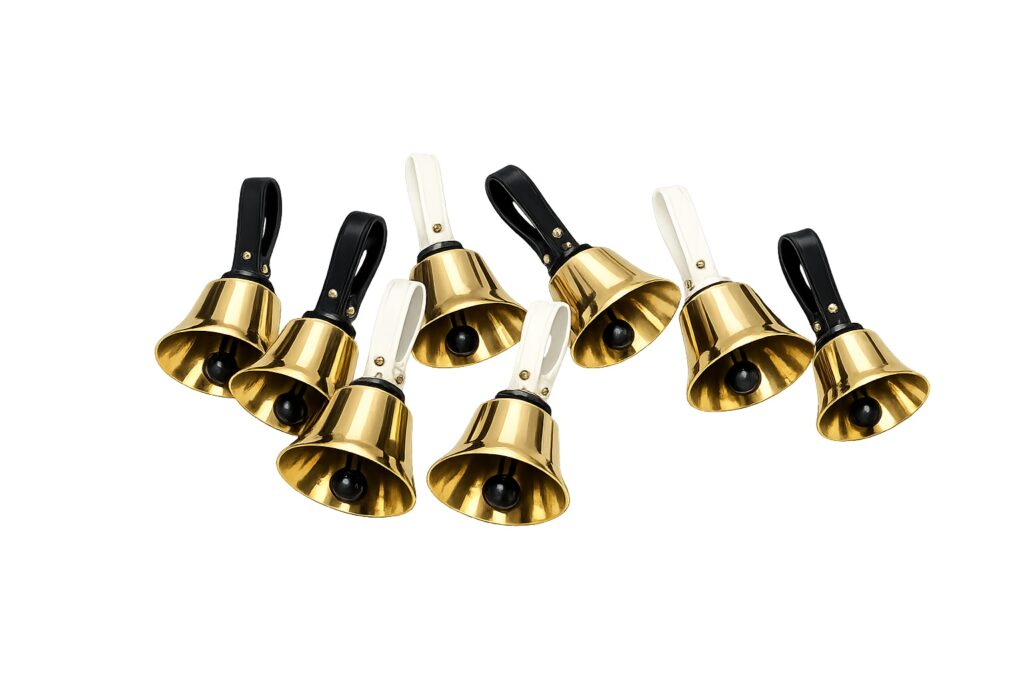
We currently have use of a set of 12 bells and have a range of an octave and a half.
We are pleased to welcome new members, and no previous experience is required, nor the ability to read music.
Our music is numerically based and easy to follow.
Our aim is to enjoy ourselves and extend our renditions of well know melodies, only limited by the number of bells.
We are currently focusing on ringing carols for Christmas, and this will help all to adapt to ringing and enjoying the music created by their efforts.
The 11th of September, the inaugural meeting of the Handnell group.
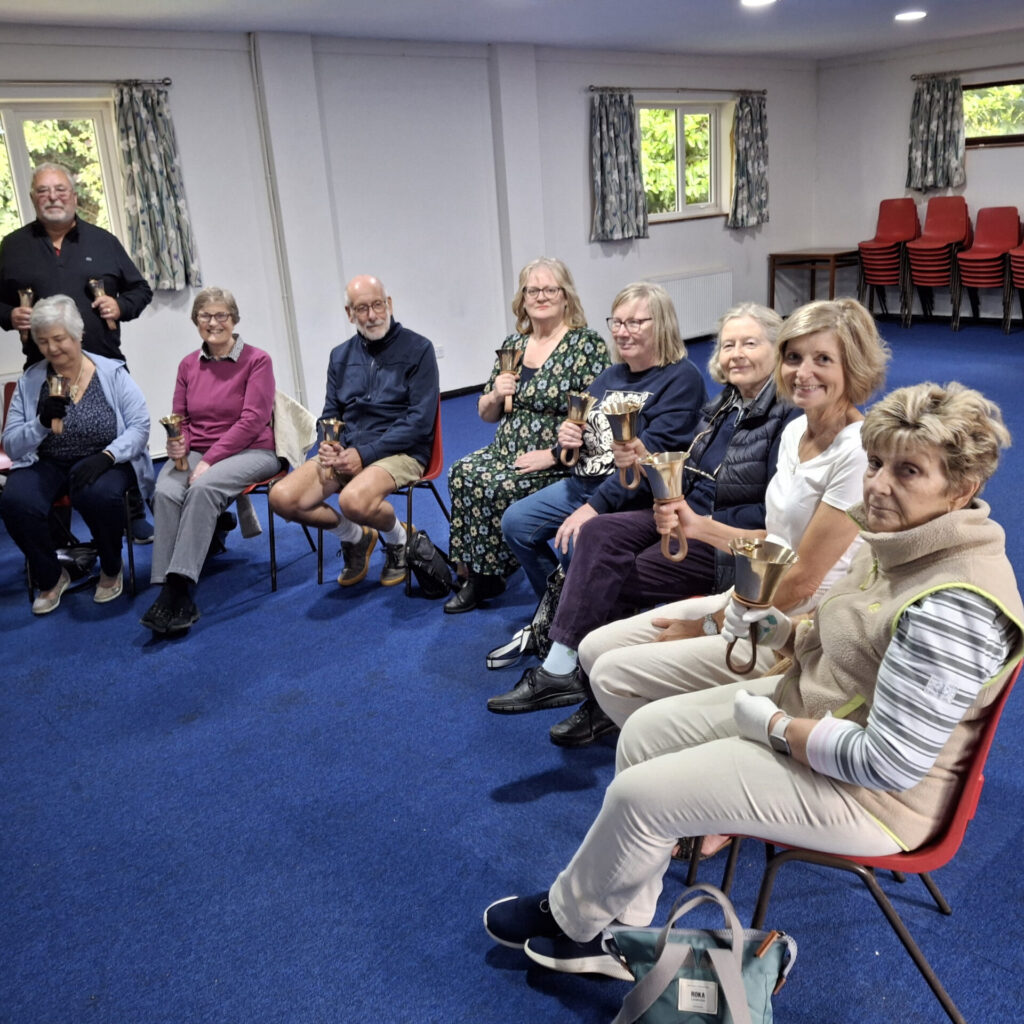
Our group held its inaugural meeting on 11th September '24 with 10 members in attendance
At our first meeting the Group, with little or no previous experience managed very presentable rendition of the carols 'Away in a manger', 'Mary's boy child', and 'Hark the Herald Angels'.
A very good first session. All the group participated in ringing 1 or 2 bells and were comfortable with the music, as well as interchanging their bells.
Our audience of one was even moved to record our best efforts, and was suitably impressed, or so he said!
Pre Christmas 2025
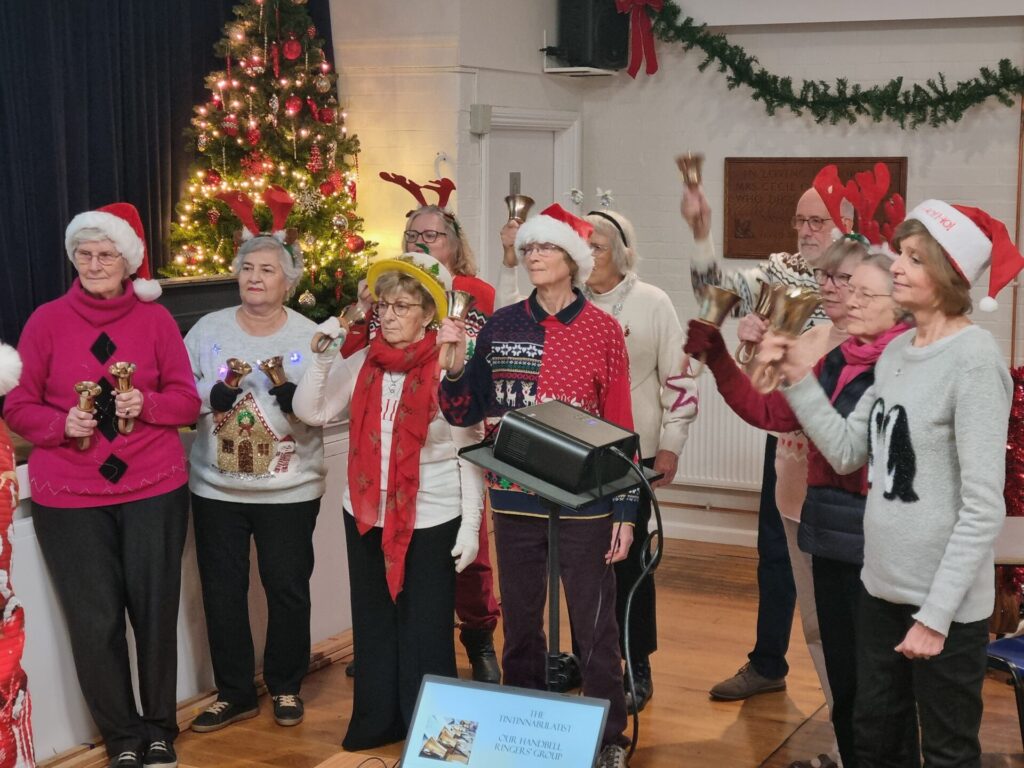
The U3A Ringers were very pleased to be invited to visit and play for the ‘MOVERS AND SHAKERS’ at the VIBE Church in Downley on Wednesday 19th November.
It was a very interesting morning, all the ringers having to battle through the snow falling in High Wycombe but arriving in good time before our audience!
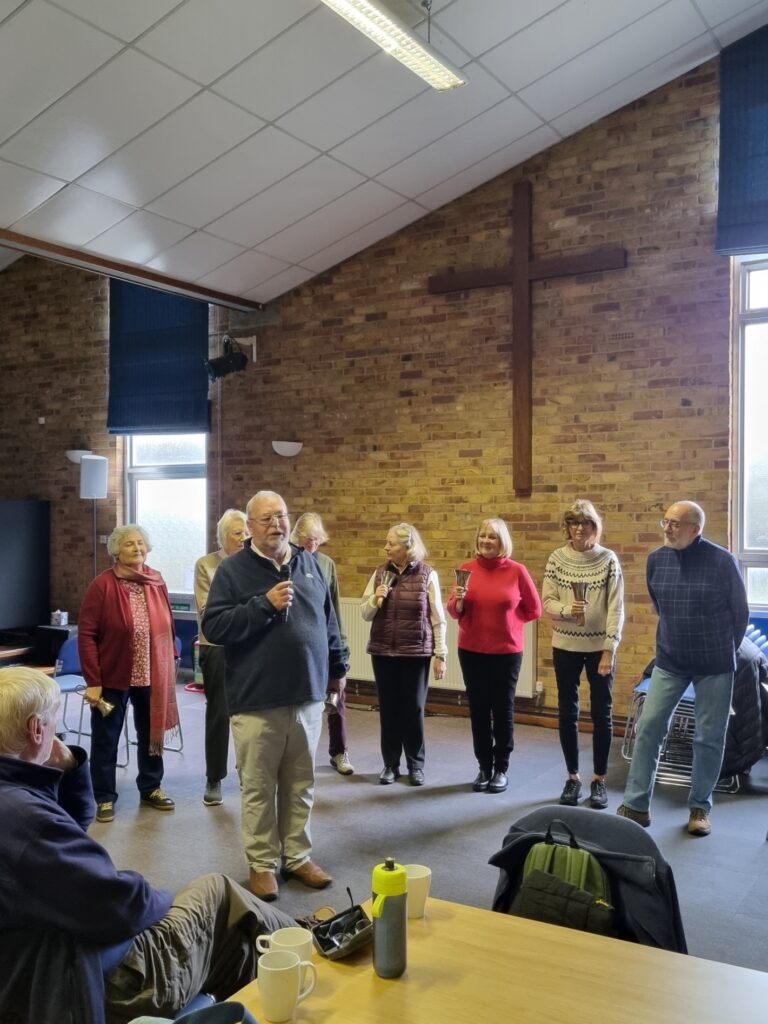
Our Audience were the Movers and Shakers a group linked to the Church where they meet for coffee, chat and some targeted exercises. We started the proceedings with a general talk on the history of Bells and handbells, which included our exercise to show the working of change ringing. (Interestingly we also learnt that the Church in the Pastures was very close to the site of an old bell foundry in Bellfields in Downley).
The audience was then treated to a rendition of many of the popular carols played on the bells. The early playing of carols was received well and enjoyed by all, and prompted the audience to join in by singing along. Many thanks to the band that played and brought an early glimpse of Christmas spirit to the gathering.
I was fortunate to be able to pop along to see this performance. A most enjoyable morning. (web Editor).
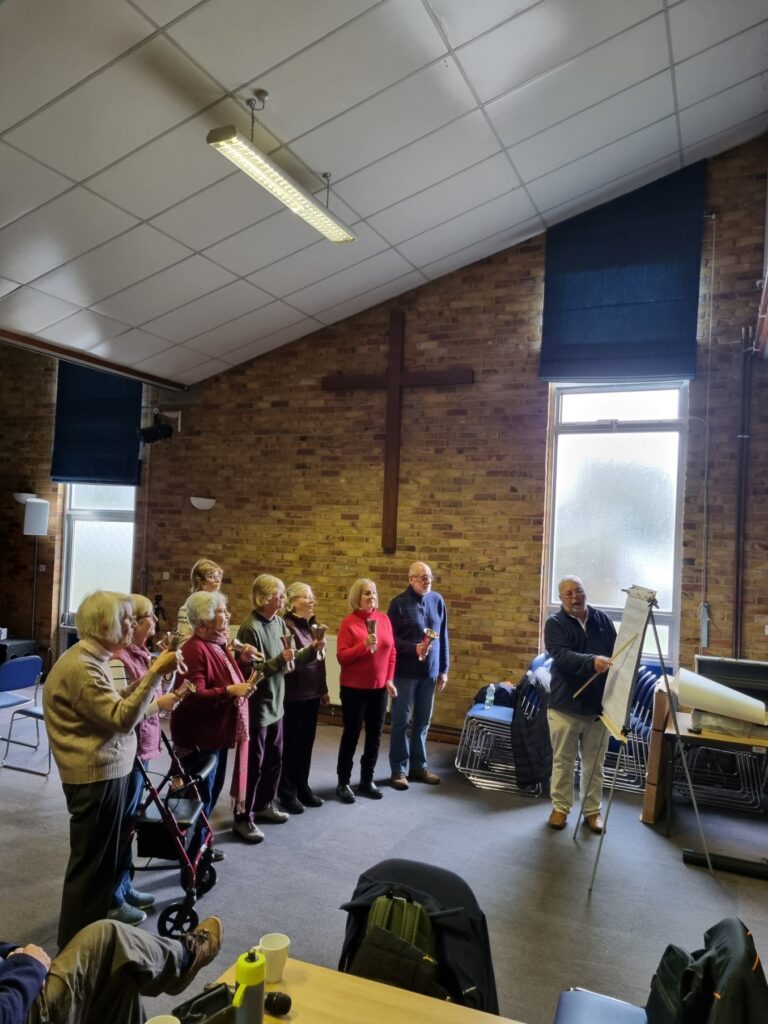
The U3A ringers have been requested, and are hoping to visit a retirement home in Marlow in December to play carols for them, and we look forward to adding this to our program.
The group will also be attending and playing at the U3A Christmas Coffee Morning.
Next Meetings
- 10th December '25
- 14th January '25
A History of the bells and bell ringing
Firstly may I thank the members of the Tintinnabulation group for their efforts prior to Christmas '24 in preparing for our two main performances. The last outing at the Le De Spencer Arms, whilst having its issues, proved very successful and people are still stopping me to say how good it was to hear and see the bells. The night was very successful and I understand a good sum of money was raised for charity.
This month meeting we started the session catching up with some of the history of bells and ringing of bells. I thought it may be of interest to refresh this and give a little more explanation as to basic change ringing we performed in our merry dance in the hall.
This month meeting we started the session catching up with some of the history of bells and ringing of bells. I thought it may be of interest to refresh this and give a little more explanation as to basic change ringing we performed in our merry dance in the hall.
Bells go way back in history and we know of ritual usage of bells in China and Egypt over 5000 years ago and in many other religions as a means warding off evil spirits/ bringing luck. Bells had many other usages apart from rituals. In modern times we think of Church bells used to call people to church, but prior to that they were used to warn of danger, time keeping, signalling and a means of communication. The Romans in Britain introduced the CURFEW Bell signalling the closure of city of London gates and also signalling a time for rest. (Curfew coming from the French, Courve le Feu, meaning cover the fire).
Even in the 1940’s WWII bells were to signal an invasion, and at Lords MCC ground a bell is sounded for the start of play each day of a test match.
The Church however did not adopt Bells until 500-600 AD when in Italy bells were first used. At this time bells were either struck or swung to be rung creating a chime.
There are three main ways of ringing and there are:
- Hammer striking a Bell ( eg BIG BEN)
- Chiming a bell ( swinging a bell so clapper strikes bell)
- Ringing of bells when bell turns through 360 degrees, and bell strikes the clapper, gaining full harmonics of the bell.
In the earliest examples of bells, these were often caste in the back of the church from an alloy of 78% Copper and 22% Tin. The tuning process was crude and comprised of chiselling metal off the inner bow of the bell to get a desired note. The bells were attached to a headstock and bearings, to allow the bell to be freely swung and chimed.
It was not until the 16/17th century that wheel was introduced to make ringing easier and allow more control of the ring. Even today you can still find various versions of the wheel in use (1/2 or Full wheel). The wheel allows for the bell to transvers 360 degrees each and every ring of the bell. The positioning of the rope and lever effect it produces reduces the energy required to ring a bell. You can see from the diagram below you produce a hand stroke and back stroke situation.
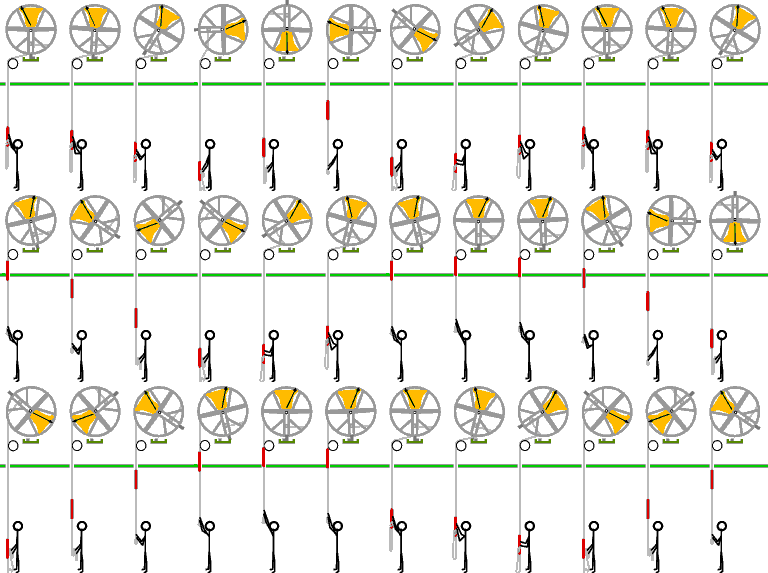
With the introduction of the wheel, it meant bells could be far better controlled, rather than the cacophony of bells you may hear in Italy.
The oldest bells still ringing in Britain are to be found in St Lawrence church in Ipswich, and these bells date back 1450 and are known as the WOLSEY bells in the Archbishops honour. They were rehung in 2009 and are still being rung to date.
Bells range in size and the biggest ones are:
TSAR Bell in Moscow (180mts) 1655
Grt PAUL in London (16 ½ mts)
Grt GEORGE in Liverpool (14mts)
Ringing of bells invariably consists of ringing a series of rounds from top notes to the bottom bells. Each strike of a bell usually takes around 2 seconds, so tune ringing is not common.
Rounds and Call changes are the simplest means of changing bell orders to produce a musical change, and each bell can be moved only one place in each set of rounds ( eg 123456 goes to 124356)
There are a series of musical rounds changes a bell conductor may aspire to achieve, namely:
13572468 Queens
75312468 Kings
15263748 Titums
12753468 Whittingtons
Tune ringing on church bells are best achieved through the use of a CARILON, which is a hammer system to strike each bell as the tune requires.
Systematically varying the order of the bells(change Ringing) started 1650-1700, and hence the phrase Ringing the Changes entered our language!
In principle the order of the bells changes, either forward or back, with each round by ONE position, and the bells follow the same pattern but starting from a different point in the circle. This is where our dance of the last meeting came about ! It was a means of ringing rounds and changing the order, each and every time, BUT NOT repeating a single combination until finishing in the original round.
The most basic series of changes is known as Plain Hunt where all bells progress to change order until it reaches its original position, as below:
1 2 3 4 5 6
2 1 4 3 6 5
2 4 1 6 3 5
4 2 6 1 5 3
4 6 2 5 1 3
6 4 5 2 3 1
6 5 4 3 2 1
5 6 3 4 1 2
5 3 6 1 4 2
3 5 1 6 2 4
3 1 5 2 6 4
1 3 2 5 4 6
1 2 3 4 5 6
Over time change methods evolved and ringers found patterns (known as methods) to ensure the maximum number of changes can be made without repeating one combination before ending in initial rounds. Each new method adopted the name of the location they were originally rung (eg Bristol/London/Lower Winchendon…..)
The maximum permutations achievable on the various number of bells is :
| Number of Bells | Number of Changes | Time to Ring |
| 1 | 1 | |
| 2 | 2 | |
| 3 | 6 | |
| 4 | 24 | |
| 5 | 120 | 6 mins. |
| 6 | 720 | 36 mins |
| 7 | 5040 | 3 hours |
| 8 | 40320 | 24 hours |
| 9 | 362880 | |
| 10 | 3628800 |
TINTINNABULATION
Ringing of handbells started in the 16/17 centuries when Church bell ringers used handbells to practice the art of ringing to avoid the darkness and cold of towers. This initially was a Northern based activity but quickly spread throughout Britain. There were many foundries based in the north of Yorkshire and elsewhere making Bells and handbells and Mears and Steinbank, Whitechapel, and Taylors of Peterborough became famous, although Taylors is the only remaining foundry today.
In the mid to late 1800s bells were exported to USA in great numbers and choirs of in excess of 250-300 bells were formed, playing a massive range of music.
Today the art of handbell ringing remains very popular in the USA / Korea / UK but costs has seen the demise of traditional usages in schools.
Handbell Ringers Great Britain is an organisation comprising of many handbell groups giving support, advice and music to many of the choirs and individuals in the UK.
This year through the HRGB contacts and family group I have acquired some very challenging music and includes some favourite pieces like
Trumpet Voluntary
Beatles Medley
St Anthonys Corale
Ragtime Rhapsody
Rest assured we will be back to an even greater range of Carols for Christmas!!
Future meetings
Meeting on the 2nd Wednesday of each month at 2.30pm
- Wednesday 12th March
- wednesday 9th april
- wednesday 14th May
We are pleased to welcome new members, no previous experience is required,
Please contact the group convenor using the link at the top of the page.